Script breakdown sheet: free template and online maker
A breakdown sheet is one page per scene that lists everything the scene needs on the day: who is in it, what they hold, what they wear, what has to happen. A shoot is scheduled from these pages, so they are the first thing an assistant director or producer makes after the script is locked.
Download
- Blank breakdown sheet, US Letter (PDF) · A4 (PDF): print and fill in by hand.
- Filled-in example: all 22 scenes of a sample script (PDF), also in A4.
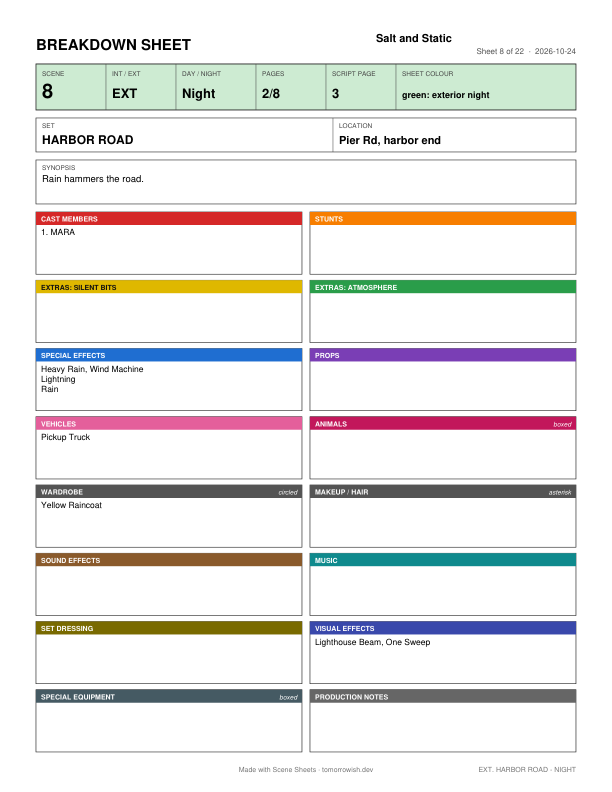
What is on the sheet
- Scene number: the number in the shooting script (12, 12A). Never renumber after the script goes out; new scenes get letters.
- INT or EXT and day or night: from the scene heading. "CONTINUOUS" and "LATER" take the time of the scene before.
- Set and location: the set is what the script calls the place (VOSS RADIO REPAIR); the location is the real address you shoot at. One location often plays several sets.
- Page count in eighths: see below.
- Synopsis: one line that says what happens, so the schedule reads without the script.
- Element boxes: cast, extras, stunts, props, vehicles, wardrobe, makeup, effects, sound, equipment and notes.
Sheet colours
The whole sheet (or its header strip) is coloured by the kind of scene, so a stack of sheets or a stripboard shows at a glance what kind of day you're building: white for interior day, yellow for exterior day, blue for interior night and green for exterior night. A few schools swap the two night colours; pick one and print a legend.
The element colour code
| Element | Usual mark | What goes there |
|---|---|---|
| Cast members | red | Speaking and named parts. Each gets a number (1 is usually the lead) that the schedule and Day out of Days use. |
| Stunts | orange | Falls, fights, car work: anything that needs a stunt coordinator. |
| Extras, silent bits | yellow | Background people who do something specific (the waitress who pours the coffee). |
| Extras, atmosphere | green | Crowds and passers-by. |
| Special effects | blue | Practical effects on set: rain, smoke, fire, breakaways. |
| Props | purple | Things the actors handle. |
| Vehicles and animals | pink | Picture cars, boats, the dog. |
| Sound effects and music | brown | Sound the scene needs on the day (playback, a song the actor sings). |
| Wardrobe | circled | Costume called for in the script. |
| Makeup and hair | asterisk | Blood, bruises, wigs, ageing. |
| Special equipment | boxed | Cranes, process trailers, a boat for camera. |
The classic colours as film schools teach them (sources: How to Film School, Filmmaker IQ, both read October 24, 2026). Nobody fixed colours for the newer categories (set dressing, visual effects, music on its own), so every sheet should carry its own legend; Scene Sheets prints the category name on every box.
Page eighths
Each script page is divided into eight parts of about an inch. A scene is measured from its heading to the next heading and written in whole pages plus eighths: 3/8, 1 2/8. No scene is shorter than 1/8. Schedules use eighths because a day's work is planned in pages: a small crew might plan three to five pages a day.
Scene Sheets counts eighths from a standard screenplay layout (12-point Courier, 54 lines on a Letter page). We checked the count against the lengths Final Draft itself stores in the three sample scripts published with the Fountain format: every comparable scene came out within 1/8 of Final Draft's figure (239 of 239), and about two thirds matched exactly. Opening a .fdx uses Final Draft's own numbers.
Filling in a sheet by hand
- Number the scenes and mark each heading's INT/EXT and day/night.
- Read each scene once for the story, then again with a highlighter per category from the table above.
- Copy each marked item into its box. List cast by number and name.
- Measure the page count and write a one-line synopsis.
That takes a few minutes a scene. Scene Sheets does steps 1 and 4 and suggests most of step 2 from the script's own words (character names, capitalised props, words like "rain" or "truck"); you confirm each suggestion and add what it missed.
More: breakdown sheet · how to break down a script · Day out of Days · call sheet template · Fountain to PDF · free breakdown software compared
Not affiliated with Final Draft, Entertainment Partners (Movie Magic), Jungle Software (Gorilla), StudioBinder or the Fountain project. Sample pages use a short script written for this tool; the people and places in it are made up.